Journal Of Agroecology

Journal Of Agroecology

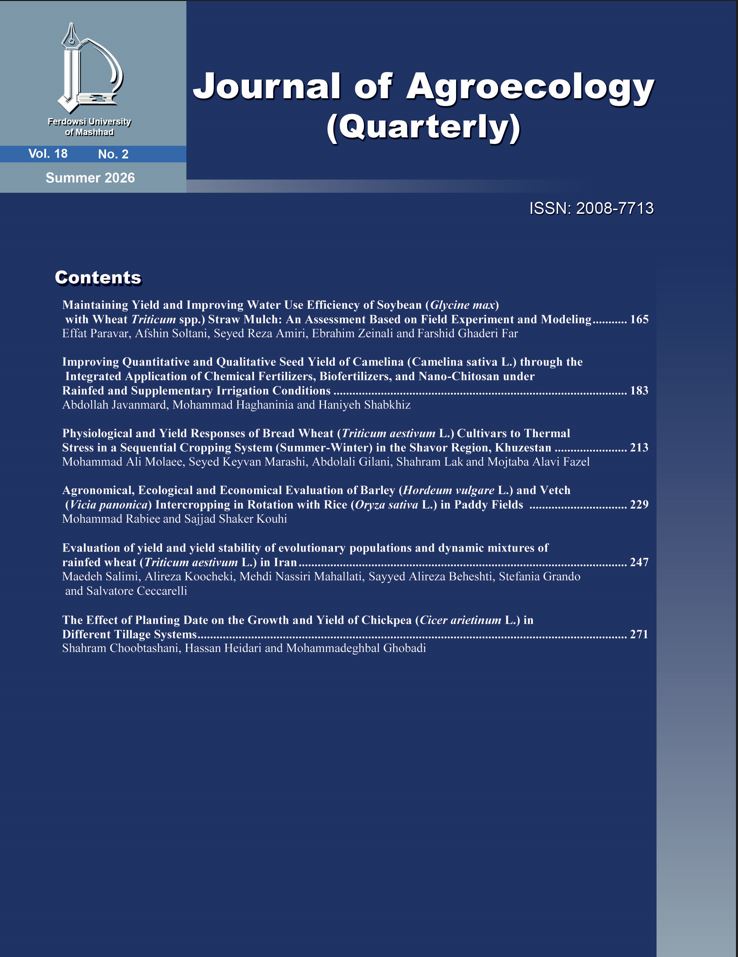
Physiological and Yield Responses of Bread Wheat (Triticum aestivum L.) Cultivars to Thermal Stress in a Sequential Cropping System (Summer-Winter) in the Shavor Region, Khuzestan

Document Type : Scientific - Research

Authors
1 Department of Agronomy, Ahv. C., Islamic Azad University, Ahvaz, Iran
2 Department of seed and plant Improvement Research, Khuzestan Agricultural and Natural Research and Education Center, Agricultural Research, Education and Extension Organization (AREEO), Ahvaz, Iran.
3 Department of Agronomy, SR.C., Islamic Azad University, Tehran, Iran
Abstract
Introduction
Wheat (Triticum aestivum L.) is a strategic crop for Iran's food security, but in tropical regions like Khuzestan, terminal heat stress severely limits its production. A sequential double-cropping system (summer-winter) has been proposed to maximize land use efficiency. In this system, the first crop is sown in late summer (September-October), and the second crop is sown immediately after harvest in winter (January-February). The summer crop faces high soil temperature at germination but benefits from rapid early growth, while the winter crop encounters cold stress at early stages followed by terminal heat stress during grain filling. Therefore, the success of this system depends on selecting suitable cultivars and optimal sowing dates to manage temperature stresses in both cycles.

Materials and Methods
This research was conducted over two cropping years (2022-2023 and 2023-2024) as a Randomized Complete Block Design with a split-plot arrangement. The main factor included four sowing dates (September 11, September 21, October 1, and October 11), and the sub-factor included four wheat cultivars (Mehregan, Chamran-2, Ayeeneh, and Sarang). Winter cropping was performed immediately after the summer harvest on four corresponding sowing dates: January 15, January 20, January 30, and February 4. Physiological indices including leaf area index (LAI), total dry weight (TDW), crop growth rate (CGR), net assimilation rate (NAR), and leaf area duration (LAD) were measured, and grain yield was determined for both cropping cycles. Data from both years were combined and subjected to analysis of variance, and mean comparisons were performed using an appropriate statistical test.
Results and Discussion
The results showed that sowing date, cultivar, and their interaction significantly affected all physiological traits and grain yield. The highest total dry weight (795 g.m-²) and crop growth rate (15.74 g.m-². day-1) were observed in the sowing date October 1/January 30 with the Chamran-2 cultivar. The highest net assimilation rate (16.18 g.m-². day-1) was also obtained in the same treatment. This superiority can be attributed to the favorable synchronization of the rapid growth phase with moderate temperatures in autumn and early spring, as well as the longer growth duration (135 days) and better heat tolerance of the Chamran-2 cultivar. However, the Mehregan cultivar on the sowing date October 11/February 4 showed a different performance pattern. Despite having moderate or even low values in some physiological indices such as CGR and NAR, it exhibited the highest leaf area index (4.30), the highest leaf area duration (24.55 days), and consequently the highest mean grain yield (1408 kg. ha-1) compared to other treatments. The superiority of Mehregan can be explained by its high leaf area duration, which reflects sustained photosynthetic activity over a longer period, and its specific adaptation to water-limited and saline conditions, enabling it to maintain green leaf area even under late sowing dates. In contrast, Chamran-2 and Sarang cultivars, despite their superiority in instantaneous physiological indices (CGR and NAR) at specific sowing dates (especially October 1/January 30), showed lower final yields. This was primarily due to their significantly reduced leaf area index (3.96-3.98) and leaf area duration (17.75-19.75 days), indicating greater susceptibility to terminal heat stress and accelerated leaf senescence during the reproductive stages.

Conclusion
Overall, the success of the sequential cropping system in tropical regions depends on selecting tolerant cultivars and optimal sowing dates. Leaf area index and leaf area duration play a more critical role in final yield compared to other physiological indices. The Mehregan cultivar on the sowing date October 11/February 4 is recommended for this system. Furthermore, the results of this study can serve as a practical guideline for farmers and agricultural managers in Khuzestan and similar warm regions to enhance land use efficiency and achieve sustainable wheat production through double-cropping systems.
Keywords
Subjects

Authors retain the copyright. This is an open access article distributed under Creative Commons Attribution 4.0 International License (CC BY 4.0)

1.         Acevedo, E., Silva, P., & Silva, H. (2002). Wheat growth and physiology. FAO Plant Production and Protection Series, 30, 39-70.
2.         Asseng, S., Ewert, F., Martre, P., Rötter, R. P., Lobell, D. B., Cammarano, D., Kimball, B. A., Ottman, M. J., Wall, G. W., White, J. W., Reynolds, M. P., Alderman, P. D., Prasad, P. V. V., Aggarwal, P. K., Anothai, J., Basso, B., Biernath, C., Challinor, A. J., De Sanctis, G., Doltra, J., Fereres, E., Garcia-Vila, M., Gayler, S., Hoogenboom, G., Hunt, L. A., Izaurralde, R. C., Jabloun, M., Jones, C. D., Kersebaum, K. C., Koehler, A.-K., Müller, C., Naresh Kumar, S., Nendel, C., O’Leary, G., Olesen, J. E., Palosuo, T., Priesack, E., Rezaei, E. E., Ruane, A. C., Semenov, M. A., Shcherbak, I., Stöckle, C., Stratonovitch, P., Streck, T., Supit, I., Tao, F., Thorburn, P., Waha, K., Wang, E., Wallach, D., Wolf, J., Zhao, Z., & Zhu, Y. (2015). Rising temperatures reduce global wheat production. Nature Climate Change, 5(2), 143-147. https://doi.org/10.1038/nclimate2470
3.         Climate Data. (2015). Climate: Khuzestan. https://en.climate-data.org/asia/iran/khuzestan-2094/
4.         Bahalkeh, G., Biabani, A., Sabouri, H. & Fallahi, H. (2021). Effect of Sowing Date on Grain Yield and Yield Components of Wheat Cultivars under Dryland Condition. International Journal of Food Science and Agriculture. 5(4):574-583.  https://doi.org/ 5. 574-583. 10.26855/ijfsa.2021.12.003.
5.         FAO. (2022). Wheat production in arid and semi-arid regions: Cultivar selection and management. Food and Agriculture Organization of the United Nations. https://www.fao.org/wheat-production
6.         Farooq, M., Hussain, M., & Siddique, K. H. M. (2014). Drought stress in wheat during flowering and grain-filling periods. Critical Reviews in Plant Sciences, 33(4), 331-349. https://doi.org/10.1080/07352689.2014.875291
7.         Fischer, R. A. (2011). Wheat physiology: A review of recent developments. Crop and Pasture Science, 62(2), 95-114. https://doi.org/10.1071/CP10344
8.         Hamzei, J., & Zarei, M. (2024). Evaluation of growth indices, yield performance and advantages in intercropping of wheat, soybean and corn. Journal of Agricultural Science and Sustainable Production, 34(3), 1-18. (In Persian with English Abstract). https://doi.org/10.22034/saps.2023.54328.2953
9.         Hatfield, J. L., & Prueger, J. H. (2015). Temperature extremes: Effect on plant growth and development. Weather and Climate Extremes, 10, 4-10. https://doi.org/10.1016/j.wace.2015.08.001
10.      Hunt, R. (1978). Plant growth analysis. CABI Databases, 67pp., U.K.
11.      Jafari, A., Rahnama, A., & Lorzadeh, S. (2021). Evaluation effective traits on crop production of bread wheat under warm and dry climate condition (Khuzestan province, southwest of Iran). Journal of Crop Nutrition Science, 7(4), 46-58. (In Persian with English Abstract). https://oicpress.com/jcns/article/view/5959
12.      Javahari, M. (2022). Identification and introduction of new bread wheat cultivars to replace old cultivars in warm regions of Kerman province. Journal of crop science research in arid regions. 4 (1):  87-95. (In Persian with English Abstract).
13.      Kawa, A.A., Amin, S.M., & Abdullah, R.A. (2021) Late sowing date influence on wheat and triticale crop yields as a draught management tool. Journal of the Saudi Society of Agricultural Sciences. 20(5), 353-358. https://doi.org/10.1016/j.jssas.2021.04.002
14.      Koocheki, A., & Sarmadnia, G. H. (2013). Physiology of crop plants (F. P. Gardner, R. B. Pearce, & R. L. Mitchell, Authors). Jihad Daneshgahi Press, Mashhad Branch, 400 pp. (In Persian).
15.      Li, L., Guan, X., Wen, P., & Wang, T. (2026). Advancement and challenges of wheat-maize double cropping system in China. Crop and Environment, 5(3), 100131. https://doi.org/10.1016/j.crope.2026.100131
16.      Liu, B., Asseng, S., Müller, C., Ewert, F., Elliott, J., Lobell, D. B., Martre, P., Ruane, A. C., Wallach, D., Jones, J. W., Rosenzweig, C., Aggarwal, P. K., Alderman, P. D., Anothai, J., Basso, B., Biernath, C., Cammarano, D., Challinor, A., Deryng, D., De Sanctis, G., Doltra, J., Fereres, E., Folberth, C., Garcia-Vila, M., Gayler, S., Hoogenboom, G., Hunt, L. A., Izaurralde, R. C., Jabloun, M., Jones, C. D., Kersebaum, K. C., Kimball, B. A., Koehler, A.-K., Kumar, S. N., Nendel, C., O’Leary, G. J., Olesen, J. E., Ottman, M. J., Palosuo, T., Prasad, P. V. V., Priesack, E., Pugh, T. A. M., Reynolds, M., Rezaei, E. E., Rötter, R. P., Schmid, E., Semenov, M. A., Shcherbak, I., Stehfest, E., Stöckle, C. O., Stratonovitch, P., Streck, T., Supit, I., Tao, F., Thorburn, P., Waha, K., Wall, G. W., Wang, E., White, J. W., Wolf, J., Zhao, Z., & Zhu, Y. (2016). Similar estimates of temperature impacts on global wheat yield by three independent methods. Nature Climate Change, 6(12), 1130-1136. https://doi.org/10.1038/nclimate3115
17.      Prasad, P. V. V., Pisipati, S. R., Momčilović, I., & Ristic, Z. (2011). Independent and combined effects of high temperature and drought stress during grain filling on plant yield and chloroplast EF-Tu expression in spring wheat. Journal of Agronomy and Crop Science, 197(6), 430-441. https://doi.org/10.1111/j.1439-037X.2011.00477.x
18.      Radford, P. J. (1967). Growth analysis formulae – their use and abuse. Crop Science, 7(3), 171-175. https://doi.org/10.2135/cropsci1967.0011183X000700030001x
19.      Rahmati, H., & Nakhzari Moghadam, A. (2023). Evaluation of agronomic and physiological characteristics of durum wheat cultivars under rainfed and supplementary irrigation conditions. Cereal Biotechnology and Biochemistry, 2(4), 446-467. (In Persian with English Abstract). https://doi.org/10.22126/cbb.2024.10445.1068
20.      Ren, A., Sun, M., Wang, P., Xue, L., Lei, M., Xue, J., & Yang, Z. (2019). Optimization of sowing date and seeding rate for high winter wheat yield based on pre-winter plant development and soil water usage in the Loess Plateau. Journal of Integrative Agriculture. 18(1), 33-42. https://doi.org/10.1016/S2095-3119(18)61980-X
21.      Reynolds, M. P., Foulkes, M. J., Slafer, G. A., Berry, P., Parry, M. A. J., Snape, J. W., & Angus, W. J. (2012). Achieving yield gains in wheat. Plant, Cell & Environment, 35(10), 1799-1823. https://doi.org/10.1111/j.1365-3040.2012.02588.x
22.      Richards, R. A., Rebetzke, G. J., Watt, M., Condon, A. G., Spielmeyer, W., & Dolferus, R. (2014). Breeding for improved water productivity in temperate cereals: Phenotyping, quantitative trait loci, markers and the selection environment. Functional Plant Biology, 41(2), 135-148. https://doi.org/10.1071/FP09219
23.      Sadras, V. O., & Calderini, D. F. (2015). Crop physiology: Applications for genetic improvement and agronomy (2nd ed.). Academic Press. 564 pages
24.      Sinclair, T. R., & Muchow, R. C. (2013). Radiation use efficiency. Advances in Agronomy, 65, 215-265. https://doi.org/10.1016/S0065-2113(08)60914-1
25.      Slafer, G. A., & Rawson, H. M. (1994). Sensitivity of wheat phasic development to major environmental factors: A re-examination of some assumptions made by physiologists and modellers. Australian Journal of Plant Physiology, 21(4), 393-426. https://doi.org/10.1071/PP9940393
26.      Thakur, P., Kumar, S., Malik, J. A., Berger, J. D., & Nayyar, H. (2010). Cold stress effects on reproductive development in grain crops: An overview. Environmental and Experimental Botany, 67(3), 429-443. https://doi.org/10.1016/j.envexpbot.2009.09.004
27.      Wahid, A., Gelani, S., Ashraf, M., & Foolad, M. R. (2007). Heat tolerance in plants: An overview. Environmental and Experimental Botany, 61(3), 199-223. https://doi.org/10.1016/j.envexpbot.2007.05.011
28.      Yusuf, M., Kumar, S., Dhaka, A., Singh, B., & Bhuker, A. (2019). Effect of Sowing Dates and Varieties on Yield and Quality Performance of Wheat (Triticum aestivum L.). Agricultural Science Digest - A Research Journal. 39(4): 306-310. https://doi.org/ 10.18805/ag. D-4977
Send comment about this article
Enter Name.
Enter a valid email address.
Enter a vaid affiliation.
Enter comments (At leaset 10 words)
CAPTCHA Image
Enter Security Code Correctly.

  • Receive Date 11 March 2026
  • Revise Date 26 May 2026
  • Accept Date 10 June 2026
  • First Publish Date 22 June 2026